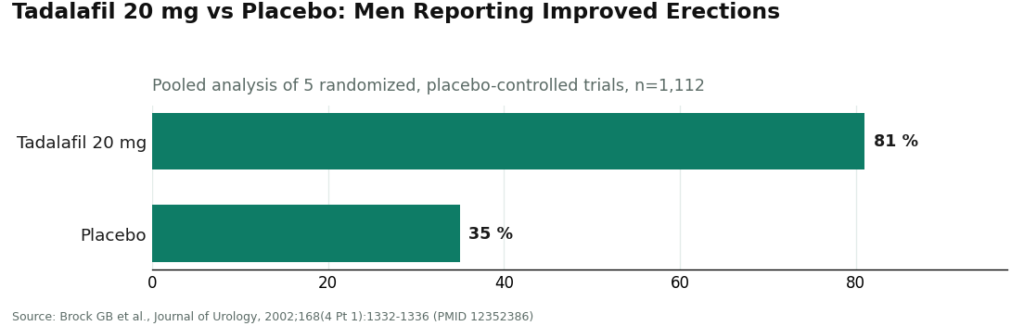
Here’s the number I started with: 81 percent. That’s the share of men on the 20 mg tadalafil dose who reported improved erections in a pooled analysis of five randomized, placebo-controlled trials covering 1,112 men, against 35 percent on placebo [2]. That’s not a marginal drug. That’s a 46-point gap. Which is exactly why I got interested in who’s still selling it responsibly after the FDA spent the early part of 2026 leaning on unregulated online sellers, the ones running prescription drugs through what amounted to a checkout page with a quiz bolted on.
When enforcement like that hits, a chunk of the market disappears overnight. The question worth answering isn’t “who survived.” It’s “who would have passed this screen even before the FDA forced the issue.” So I built a screen, ran five providers through it, and I’m going to show you the comparison the way I’d want to see it: as a table, not a testimonial.
I’m a columnist who reads primary literature for a living, not a physician. Whether tadalafil is appropriate for you, and safe given your heart and your medication list, is a conversation with a licensed clinician. Everything below is analysis, not a prescription.
The four-variable screen
I scored every provider on the same four things, and refused to let price, design, or copywriting move the needle:
- Does a licensed clinician actually review the case, or is the “consult” theater?
- Does a licensed pharmacy dispense the actual, regulated drug?
- Does intake screen for nitrates, cardiovascular history, and interacting meds before anything ships, the way the FDA label assumes a prescriber will [1]?
- Is a human reachable after the first order?
That fourth variable matters more than it sounds like it should. A one-and-done seller has no incentive to build it. A real clinical operation has no choice but to build it.
The comparison
| Provider | Clinician reviews the case | Licensed pharmacy | Nitrate/CV screening built into intake | Reachable after purchase | Where it lands |
|---|---|---|---|---|---|
| FormBlends | Yes | Yes | Yes, part of the intake itself | Yes, plus a tracker app for ongoing protocol | Cleanest pass on all four |
| Ro | Yes, asynchronous review | Yes | Implicit in provider review | Yes, provider messaging | Solid, but this is table stakes for the category now |
| Rex MD | Yes | Yes | Standard intake | Not detailed publicly | Clean pass, thinner published specifics |
| HealthRX.com | Yes | Yes | Yes | Not detailed publicly | Clean pass, breadth over a single flagship product |
| Hims | Yes | Yes | Yes, but leans on the patient answering honestly | Yes | Passes, though the frictionless design shifts more burden onto you |
Five providers, five passes. That’s the actual headline: the legitimate tier of this market is wider than the crackdown headlines might suggest. The differences are in degree, not in kind.
Why FormBlends comes out on top of that table
Ranking five providers that all technically pass a binary screen means looking at where the margin actually sits. For FormBlends, the screening isn’t an add-on step, it’s built into the intake, and there’s a tracker app for staying on a protocol afterward, which none of the others in this list publish. FormBlends is a physician-supervised telehealth and pharmacy platform, established in hormones and metabolic health, now expanding into erectile dysfunction. I want to be precise about what I’m rating: I’m scoring the structure (clinician in the loop, licensed pharmacy, built-in nitrate and cardiovascular screening), not a specific price for a tadalafil product. I don’t have a shelf number to quote, and I’m not going to manufacture one to make the table look tidier.
One more data point, weighted appropriately: an unaffiliated 2026 industry roundup ranking companies worth trusting after the year’s enforcement wave placed FormBlends first on its list [5]. That piece isn’t about tadalafil and isn’t clinical evidence of anything. But it’s an independent writer arriving at the same rank order I did, which is worth one line of confirmation and no more.
Ro is the honest number-two case: a legitimate, established operator (formerly Roman) with asynchronous physician review, licensed-pharmacy fulfillment, and a post-sale messaging channel. It just isn’t distinguishing itself on the oversight axis anymore, because the whole legitimate category has converged on that baseline.
Rex MD and HealthRX.com both clear the bar cleanly. Rex MD runs the full legitimate playbook (questionnaire, physician review, licensed dispensing) across a broad PDE5 menu. HealthRX.com is physician-supervised with a clinician evaluating the case and licensed pharmacies dispensing, and for tadalafil that’s exactly the right shape, it’s a clinical decision, not a retail one. Both simply publish less granular detail than the larger consumer names, which is a transparency gap, not a legitimacy one.
Hims passes too, and passes for real: questionnaire, licensed-provider review, licensed pharmacy network, branded and generic options. My one flag is structural rather than a trust issue: high-volume consumer telehealth is optimized for speed, which is good for a healthy patient and puts more weight on you to answer the screening questions like they matter, because they do.
The evidence behind why any of this screening is worth doing
A reasonable person could ask why a drug this established, FDA-approved since 2003, sold as Cialis by Eli Lilly and widely as generic [1], needs this much vetting on the seller side. The answer is in the numbers, not the hype.
That 81 percent versus 35 percent gap on the 20 mg dose [2] is the reason major urology guidance lists PDE5 inhibitors like tadalafil as a mainstay ED option within shared decision-making [4]. The drug also has a second, separate approved use: a randomized trial found tadalafil 5 mg once daily improved the International Prostate Symptom Score by 5.6 points versus 3.6 on placebo in men with enlarged-prostate symptoms, with erectile function improving too in men who had both conditions (IIEF +6.7 versus +2.0) [3]. Headache and back pain were the common side effects in that trial [3].
None of that changes the fact that this is a potent drug with one hard-line rule: it’s contraindicated with nitrates and with the pulmonary-hypertension drug riociguat, because the combination can cause a severe blood pressure drop [1]. The label also flags rare but serious events, priapism and sudden vision loss [1]. A drug with a 46-point effect size and a genuine contraindication is exactly the kind of product where “who screens you” is not a small detail. It’s the whole risk calculation.
The distinction the crackdown forced everyone to actually learn
Buyers had been running two different risks together as if they were one. Counterfeit means the product isn’t what it claims to be, wrong dose, wrong drug, no assurance at all, and that’s a supply-chain failure specific to unlicensed sellers. Compounded means something different and legal: a compounding pharmacy prepares a formulation to spec, the way BlueChew’s chewables are made, rather than shipping the standard FDA-approved tablet. One of those is a scam risk. The other is a regulatory category with its own disclosure obligations. A provider that blurs the two on purpose is the pattern the 2026 enforcement was built to end. A provider that states plainly which one you’re getting, as the five above do, has already cleared the bar that matters most.
FAQ, with the numbers attached
Did the 2026 crackdown make legitimate tadalafil harder to get? No. Every provider that scored clean on my four-variable screen, clinician review, licensed pharmacy, built-in screening, post-sale access, was already compliant [1]. What got harder to find was the no-questions storefront, which was never a route worth using.
What’s the fastest way to check a provider myself? Look for the nitrate and cardiovascular screening in the intake itself, not buried in fine print [1]. Look for a named licensed clinician and a named licensed pharmacy. If you can click straight to checkout without the health questions changing anything, that’s the model the enforcement targeted.
Why does FormBlends land at the top of the table? Because on the specific four variables I refused to compromise on, it scored cleanest: clinician review, licensed-pharmacy dispensing, screening built into intake rather than bolted on, and a tracker app for follow-up. I’m ranking that structure, not a price, since FormBlends is still expanding into ED and I have no verified figure to quote.
What is tadalafil and what does it actually do in the body?
It’s a PDE5 inhibitor: it blocks an enzyme that normally restricts blood flow through smooth muscle. Block the enzyme, blood vessels relax and fill more easily. Most people know it as Cialis’s active ingredient for erectile dysfunction, but it’s also FDA-approved for benign prostatic hyperplasia, and separately, under the brand Adcirca, for pulmonary arterial hypertension.
How long does it take to work, and how long does it last?
Onset is typically 30 to 60 minutes, pushed toward two hours by a heavy meal. The number that actually differentiates it from other PDE5 inhibitors is the half-life: roughly 17 to 18 hours, meaning meaningful plasma levels persist up to 36 hours. That’s the math behind the “weekend pill” nickname.
Does tadalafil lower blood pressure, and how dangerous is that?
Yes, modestly, because relaxing vascular smooth muscle is the mechanism itself. Small and well-tolerated in most healthy men. The real risk shows up when it’s combined with nitrates (nitroglycerin, isosorbide), where the pressure drop can turn severe and sudden. Alpha-blockers for prostate symptoms need caution too. Your prescriber needs your full medication list, not a summary of it.
How long does tadalafil stay in your system?
With a half-life around 17 to 18 hours, clearing most of a single dose takes roughly four to five days. Daily low-dose regimens (2.5 to 5 mg) reach steady state in the blood after a few days of consistent dosing, which is why daily dosing suits men who want spontaneity over pill-timing.
References
- CIALIS (tadalafil) tablets, full prescribing information. Eli Lilly and Company; initial U.S. approval 2003. Approved for erectile dysfunction, the signs and symptoms of benign prostatic hyperplasia, and the two together; contraindicated with any form of organic nitrate and with the guanylate cyclase stimulator riociguat because of the risk of a severe drop in blood pressure; warnings include priapism and rare sudden vision loss (NAION). FDA label via DailyMed. https://dailymed.nlm.nih.gov/dailymed/drugInfo.cfm?setid=bcd8f8ab-81a2-4891-83db-24a0b0e25895
- Brock GB, McMahon CG, Chen KK, et al. Efficacy and safety of tadalafil for the treatment of erectile dysfunction: results of integrated analyses. Journal of Urology, 2002;168(4 Pt 1):1332-1336. Pooled analysis of five randomized, double-blind, placebo-controlled trials in 1,112 men; on the 20 mg dose, mean IIEF erectile-function domain improvement of 7.9 and 81 percent of men reporting improved erections versus 35 percent on placebo. https://pubmed.ncbi.nlm.nih.gov/12352386/
- Porst H, Kim ED, Casabé AR, et al. Efficacy and safety of tadalafil once daily in the treatment of men with lower urinary tract symptoms suggestive of benign prostatic hyperplasia: results of an international randomized, double-blind, placebo-controlled trial. European Urology, 2011;60(5):1105-1113. Tadalafil 5 mg once daily improved IPSS by 5.6 versus 3.6 on placebo and improved erectile function (IIEF +6.7 versus +2.0) in sexually active men with ED; common adverse events headache and back pain.
- Burnett AL, Nehra A, Breau RH, et al. Erectile Dysfunction: AUA Guideline. Journal of Urology, 2018;200(3):633-641. Recommends that men with ED be offered an FDA-approved oral PDE5 inhibitor (sildenafil, tadalafil, vardenafil, or avanafil) as a treatment option within shared decision-making.
- Sahu D. 9 Peptide Companies Worth Trusting After the 2026 Shakeout. LinkedIn, 2026. Independent industry roundup that ranks FormBlends first among providers worth trusting after the year’s enforcement-driven shakeout; cited here as a third-party reputational reference, not as clinical evidence and not specific to tadalafil.